
Adams County Deeds by Type
The Adams County Recorder accepts many instruments beyond deeds. A deed records a transfer of ownership. A mortgage, lien, easement, release, survey, or plat records something else entirely. Each Adams County property records entry gains meaning when you read the document type. Match it against the party names and the legal description. Remember that an index entry only shows the Recorder accepted an instrument for recording. It does not prove title is clear.
| Deed Type | What It Does | Common Use |
|---|---|---|
| Warranty deed | Conveys land with warranties stated in the instrument. | Ordinary sale or planned transfer |
| Quitclaim deed | Conveys whatever interest the grantor holds. | Family, estate, or corrective transfer |
| Trustee or executor deed | Records a fiduciary transfer from a trust or estate. | Estate administration |
| Tax deed | Records a conveyance from the statutory tax-sale process. | Completed tax-sale transfer |
| Cemetery deed | Conveys the specific cemetery interest described. | Cemetery lot record |
Other indexed types in the Recorder's deed records system include affidavits, assignments, contracts, mechanics liens, delinquent sewer liens, federal tax liens, powers of attorney, and UCC filings. Two files that share party names are still not interchangeable instruments. Grab the exact index label and date.
Adams County Deed Index Since 1836
Doxpop coverage information plus a February 2026 announcement describe an Adams County index. Its scanned images reach back to June 1836. The first available recorded document is dated June 23, 1836. That date puts the online starting point close to the county's organization. Older wording on the county Recorder page still mentions computerized documents from 1990 forward. It pays to test the year you need and to confirm any missing image with the office. Wide coverage is not a promise. Some old names may not have been transcribed consistently, and some scans may not be legible. The official coverage entry follows.
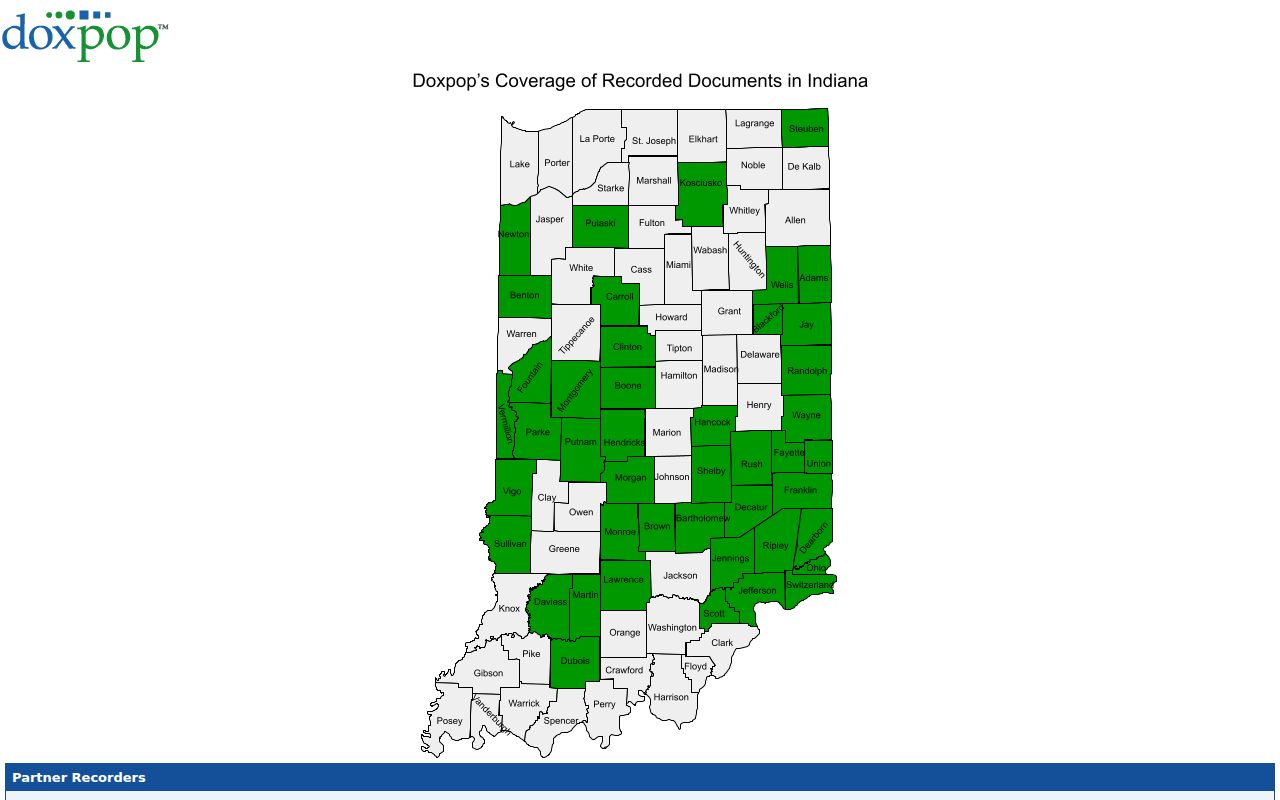
The current partner listing backs the longer date range, though record-level limits still need verification.
Search Adams County Deed Fields
The recorder's deed index opens several doors. You can search Adams County property records by party name, document number, or document type. Plat name, lot, and section-township-range work as fields too. Each field answers a different question about a parcel or deed. Exact form layouts, wildcard syntax, image fees, and login limits live inside the search system itself. The static pages do not spell those out.
| Search clue | Best use | Cross-check |
|---|---|---|
| Party name | Find grantors, grantees, borrowers, or lenders. | Try initials and entity forms. |
| Document number | Retrieve a known instrument. | Confirm date and type. |
| Document type | Separate deeds from liens and releases. | Search related instruments. |
| Plat or lot | Locate platted land. | Match the legal description. |
| Section-township-range | Locate rural tracts. | Compare acreage. |
The Doxpop Recorder entry is pictured here.
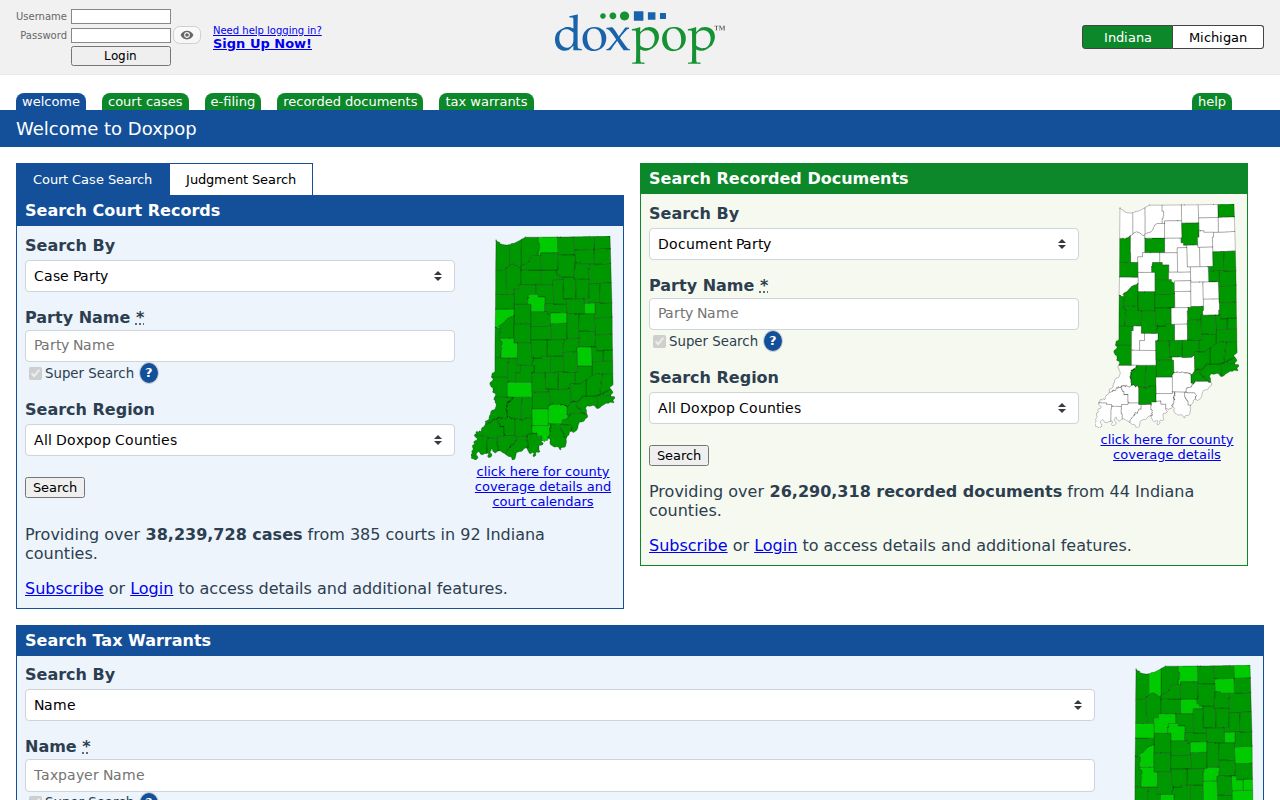
The portal begins the party search; the recorded image supplies the instrument text.
Walk the Adams County Grantor-Grantee Chain
A grantor gives up an interest in the land. A grantee takes it. Every deed in the chain names both sides. Begin with a recent deed whose legal description matches your parcel, then work backward through the Adams County deed records. Names alone will trip you up. Joint ownership, estates, trusts, entities, spelling variants, and partial tracts all create false branches, so match the legal description every step of the way.
- Find the current owner's acquiring deed with that owner as grantee.
- Save the grantor, date, legal description, type, and recording reference.
- Search that grantor as a grantee in an earlier transaction.
- Compare lot, section, acreage, and plat at each link.
- Branch for splits, estates, correction deeds, and affidavits.
- Grantor
- The party transferring the stated interest.
- Grantee
- The party receiving it.
- Chain of title
- The linked sequence of conveyances for the same land.
- Book/page or instrument number
- The Recorder reference for a recorded document.
A gap can mean many things. Another spelling, an estate transfer, a partial conveyance, or a predecessor jurisdiction could explain it. It could also simply mean the image is unavailable. None of this proves the document never existed.
Historic Adams County Owner Maps
The Indiana State Library inventory holds a rich set of Adams County owner maps. It includes an 1896 owner map, a 1900 farm-owner map, Hixson and Sidwell plat books, and later owner-indexed atlases. When a modern address fails you, these plats can surface a former road, farm, subdivision, or owner of record.
Start with the current legal description. Write it down first. Then find its township, section, subdivision, or lot on the period map, and test the historic name in Doxpop against the Adams County deed records. Be careful with what a map name proves. It may point to an occupant, an adjoining owner, or the publication-era owner rather than the sole title holder.
The inventory page lists each map and atlas in the collection.
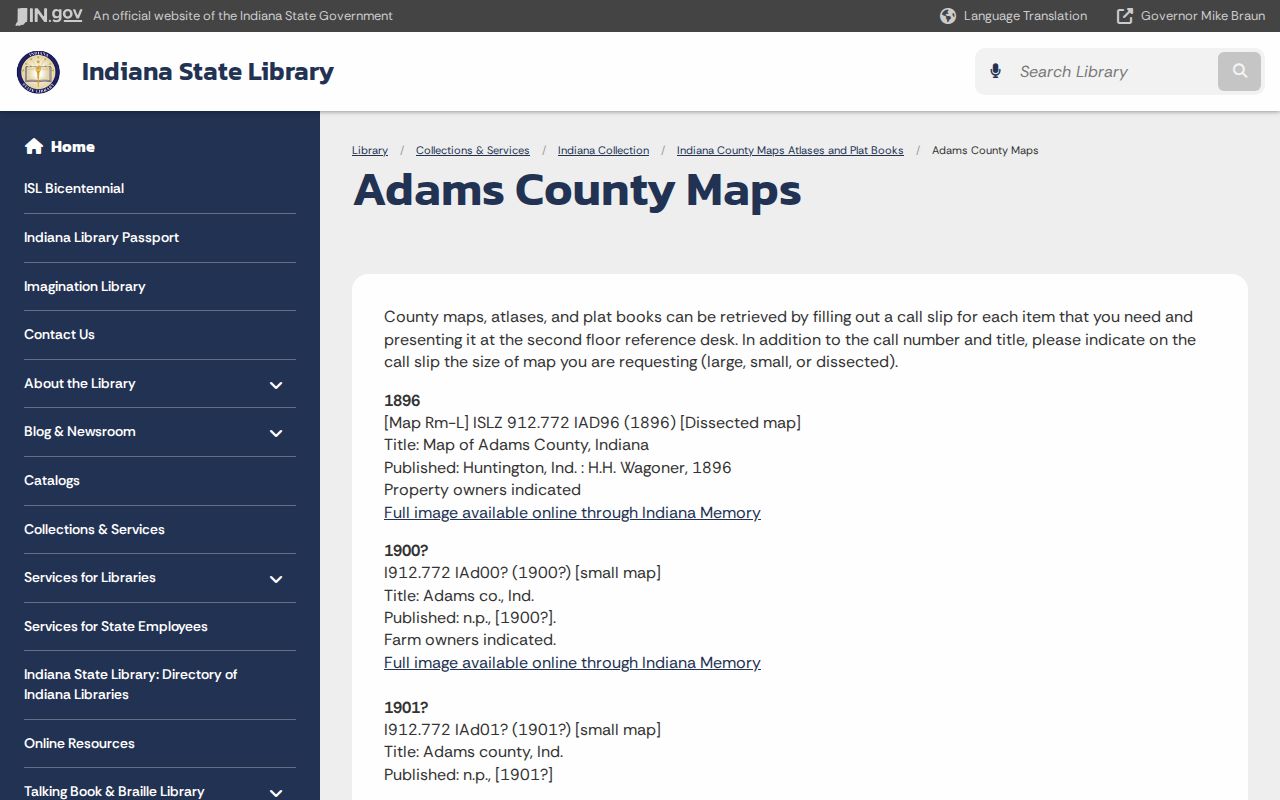
The dated sequence helps bridge older descriptions to the recorded deed chain.
Adams County Plats and Affidavits
A plat, survey, easement, or affidavit often explains a chain that skips a straight line. CountyWeb layers these details onto its Adams County maps. You can view Original Lot Lines and Original Property Lines. Subdivisions, Easements, and Combined by Affidavit overlays are also available. Treat each overlay as a lead, though. The recorded instrument remains the proof, not the map label.
Search strategy depends on the situation. For a combination, pull the old parcel numbers. Then pull the resulting parcel and the affidavit behind it. Subdivision work means matching the plat name, lot, and any replat notation. Rural parcels should keep section, township, range, and acreage handy. When a GIS label trims something short, the recorded instrument still controls.
Recording an Adams County Deed
Before an Adams County deed can be recorded, it needs acknowledgments and printed names that match the signatures. It also needs the preparer's name. Notarized papers must also show the notary's county of residence and the commission expiration. Deeds that transfer ownership take an extra route. The Assessor and the Auditor both endorse them first. That is why. A recent ownership change can show up in county property records on different schedules.
Mailed documents should include a self-addressed stamped envelope. Once recorded, the instrument goes through imaging, microfilming, processing, and proofing. The original comes back the next business day. Most documents can be e-recorded. Large plats and surveys are the exception, and transfer documents still require the endorsement steps.
Request an Adams County Deed Copy
The Adams County Recorder provides several ways to get a deed copy. Doxpop research, courthouse public-access computers, and copy service are all available. Staff will not do the searching for you. So if you lack the recording details, search first.
Know your instrument number or parties before requesting. The request should also state whether you want certification, plus a return address and contact details. The county lists a $1 per-page copy charge, so a typical direct deed copy runs about $2. Certified copies carry a separate fee under Indiana law. Cash, check, and credit card are all accepted. A 2025 ordinance discussion raised bulk-form copy pricing from $0.15 to $0.20 per page, so confirm current bulk and certification charges before ordering.
Recorded, not guaranteed. Adams County deed records show accepted instruments, not a title opinion. Unrecorded interests and priority questions require qualified title review.
Beware of costly commercial services that mail out deed-copy offers in Adams County. Going straight to the Recorder usually costs far less. Before you dig into the deed index, the Adams County property search can help. It can give you the owner of record. It also lists the legal details worth having. It saves time. It helps you spot the right parcel number fast.
When you order by mail, say whether you want a plain copy or a certified one. The same goes for the counter. Give enough recording detail to separate yourself from anyone who shares a similar name. Then confirm the current fee before you send money. Keep in mind that certification authenticates the county copy of the deed. It does not make the Recorder a title examiner. It does not settle what the instrument legally does.