
Compare Adams County Property Value Types
A value label means little alone. The same Adams County parcel can carry several legitimate figures at once, each tied to its own date and source.
| Value | What It Is | Where |
|---|---|---|
| Assessed value | Mass-appraisal amount used in tax administration | Assessor parcel fields |
| True tax value | Indiana market value-in-use standard | Assessment record and DLGF guidance |
| Last sale price | Consideration reported for a particular transfer | TaxParcels Sales table and deed context |
| Land / improvement AV | Separate assessment components that total the parcel figure | Parcel and Sales fields |
Indiana assesses at a 100 percent target ratio. But true tax value means market value-in-use. It is not automatically a prediction of fair-market price, since a transfer can be old, non-arm's-length, partial, or marked invalid for ratio-study use.
Estimate an Adams County Value from Official Fields
Find the parcel first. The Adams County ArcGIS portal identifies the parcel, and comparing assessment and sale fields then becomes a matter of matching parcel IDs and dates.
- Search the situs and confirm Parcel_ID, legal description, property class, and acreage.
- Read the land, improvement, and total assessed-value fields with their assessment year.
- Open the Sales table and compare date, price, buyer, seller, TotalAV, and Valid.
- Explain any difference by date, use, condition, assessment method, or transfer validity without inventing a market estimate.
- Assessed value
- The mass-appraisal value carried for tax administration.
- Market value-in-use
- Indiana's true-tax-value concept based on current use.
- Assessment ratio
- Assessed value divided by the relevant market-value measure.
- Sale consideration
- The amount associated with a transfer, subject to validity and deed context.
Read Adams County Sale and Assessment Fields
The county Sales table lists Date, Price, buyer, seller, parcel and legal fields, land and improvement components, TotalAV, and Valid. Check the valid code before trusting a transfer as value evidence. The parcel layer adds property class, acreage, owner, legal description, review information, and district context.
Related Sales rows can preserve several transactions. The newest figure may not be a clean sale. Confirm the deed, tract conveyed, and the parties' relationship. Also check whether the row covers the full parcel.
Note: A sale price and assessed value can both be accurate records while answering different questions about the same Adams County parcel.
Understand Adams County Annual Trending
The Indiana Department of Local Government Finance sets the state's framework. Its overview explains annual adjustment and mass appraisal. Adams County follows that framework. Assessments use a January 1 date. On-site inspections arrive on a periodic schedule set under state guidance. A value can move for several reasons. Trending, new construction, corrected characteristics, a parcel change, or a cyclical review can all shift it.
State cost-approach material lays out a four-year inspection cycle. It covers 2022 through 2025, and a new cycle starts in 2026. A parcel's ReviewYear or lister date helps explain when fieldwork happened. It is not a guaranteed owner or value update date. Treat it as timing evidence rather than proof of a change.
Keep Adams County Value Geography Precise
Sound comparisons start with geography. Adams County has twelve townships. Decatur parcels can carry Root or Washington Township district strings, while Berne and Geneva use different districts. City labels never erase township context. A nearby sale helps only when use, class, land, improvements, location, and transaction type match. A ZIP is postal geography, not a valuation district or parcel boundary.
Separate Adams County Assessed and Taxable Amounts
Deductions shrink the value used for taxes. They do not rewrite a sale price, and they may not touch the gross assessed figure. Indiana DLGF lists homestead, mortgage, over-65, disability, veteran, rehabilitation, heritage-barn, and other forms. A title change can require reapplication. This discussion stops at value fields. For deductions, bills, and appeals, use the Adams County property tax records guide, and never infer market value from the final tax due.
Align Adams County Property Values by Date
Adams County property records carry several dates that do not line up. The assessment date falls on January 1. A deed records when a sale closed. Trending shapes the following tax year. A deed date and an assessment date can sit months apart. Lay every date on one timeline before deciding a property value truly rose or fell.
Some fields need extra care. A lister or ReviewYear entry shows when inspection work happened. Yet it never guarantees that every parcel characteristic was updated that same day. A fresh deed can also reach the recorder before the parcel or tax records catch up. When two Adams County sources disagree, the Assessor or Auditor can explain which cycle and tax year produced the field in question.
For a fair long-range view, compare repeated official assessments and valid sales. Tie both to the same parcel geometry. A split, a combination, or a new improvement breaks that continuity. So does a class change or lost acreage. Note the change first. Raw totals compared across such a shift will mislead anyone reading the property records.
Explain Adams County Value Differences Without Guessing
Sale price and assessed value diverge for understandable reasons. The dates may differ, the transfer may not be a valid open-market sale, the assessment may reflect market value-in-use, or the parcel changed. Land and improvement components can move differently too. Check property class, condition fields, acreage, legal description, and Valid before settling on an explanation.
The DLGF citizen guide covers age, grade, condition, Form 11, trending, and assessment practice. It explains the framework. It does not appraise one Adams County parcel. State public figures exactly, name their purposes, and leave unsupported market estimates out.
Audit an Adams County Value Comparison
Before you weigh any numbers, gather the full context. That means the parcel number, legal description, property class, acreage, assessment year, land and improvement assessed values, total assessed value, sale date, sale price, and the validity field. A value shorn of its year invites mistakes. So does a price stripped of its deed and tract setting. Check whether a recorded transfer covered the entire parcel, a group of parcels, or only part of the land.
Adams County's Sales table brings buyer and seller data together with date, price, validity, legal, and parcel fields. The assessment components come alongside. That pairing helps explain how a transfer lines up with the public assessment. It does not turn every sale into a clean market comparable. Family transfers, entity reorganizations, estates, corrections, and partial interests can all put a recorded amount on the books. That amount should never be generalized. Treat the numbers with that caution in mind. The official Adams County Sales schema displays the comparison fields available to the public.
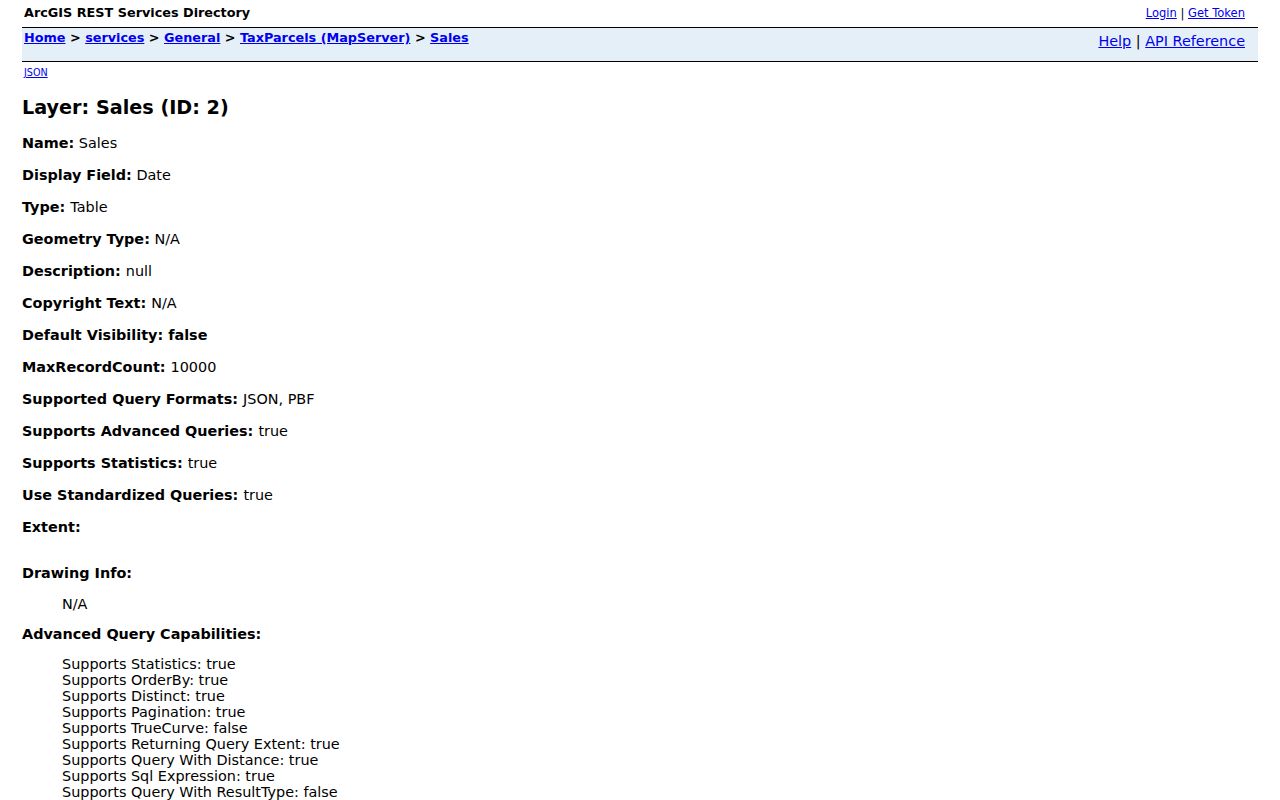
A captured sale record is only the start. Match its date and price against validity codes, the parcel number, legal description, and assessment fields. Do this before trusting the comparison. Splits and combinations are the common trap. Follow both the state and local parcel numbers, and inspect the inactive rows on the tax list. A current assessment may sit on new geometry, while the older sale points to a parent parcel. Check acreage and legal descriptions first, then calculate any difference or trend.
Use Every Adams County Value Access Channel
The online parcel and Sales services are the fastest Adams County value sources. Other channels exist. The Adams County Assessor can explain parcel characteristics along with inspection and assessment fields. The Auditor handles tax-roll certification, deductions, and transfer endorsement. The Treasurer's site adds tax-year and district context. It warns that its public list is not an official statement.
For sale evidence, search the Recorder index. You can also use the courthouse public-access computer to locate the recorded conveyance. The Recorder does not perform title searches. A requester with the instrument number, parties, and date can still pursue a copy. Court records may add context for a foreclosure or ordered sale. They never replace the deed and parcel match.
A narrow request under Indiana Code 5-14-3 should name the parcel, address, date range, and field or record sought. It should also state a preferred format. Inspection is generally free. Lawful copy or certification fees can apply. This fallback matters when a web record is incomplete. It also matters when a value field needs its underlying explanation.
Know What Adams County Assessed Value Cannot Say
An assessed value is not an appraisal. The assessor runs a mass-appraisal system across the whole tax roll. That is different from a parcel-specific appraisal commissioned for a single transaction. So the public figure cannot promise a sale price. It also cannot establish title, prove building condition, or settle a boundary dispute. When a real number matters, get a current professional appraisal. It will state its assignment and effective date for the intended purpose.
Value vs price. An Adams County assessed value supports taxation; it is not a guarantee of what the property would sell for and is not a private appraisal.
The Treasurer's tax list carries a warning of its own. It is not an official statement of the tax bill. When a figure matters, document the source, the parcel, the tax or assessment year, your query date, and whether the value is land, improvement, total, taxable, sale, or appraisal.